
Figurative language is one of the most powerful tools in English writing. It makes sentences more creative, emotional, and meaningful. Instead of using simple and direct words, figurative language helps writers express ideas in a unique and imaginative way. Whether you are a student writing an essay or a writer creating poetry, learning figurative language examples will improve your writing skills and make your content more engaging.
What is Figurative Language?
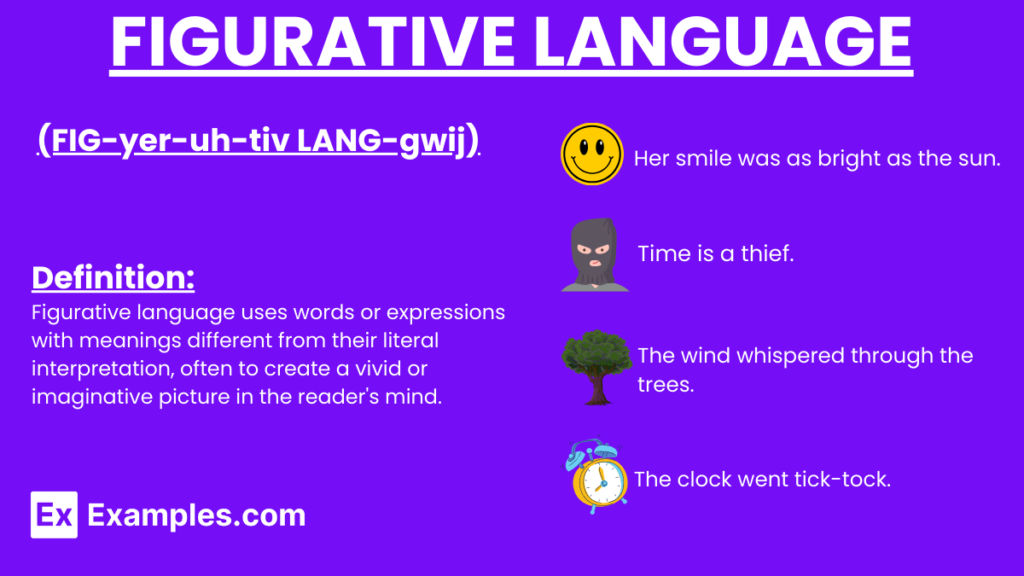
Figurative language Examples is a type of language that goes beyond the literal meaning of words. It uses comparisons, exaggerations, and symbolic expressions to create a stronger message.
In simple words, figurative language means using words in a creative way to express ideas indirectly.
For example:
- Her smile was as bright as the sun.
- Time is a thief.
These sentences are not meant to be taken literally. Instead, they create a picture in the reader’s mind.
Figurative language is commonly used in:
- Poetry
- Stories
- Speeches
- Novels
- Songs
- Advertisements
- Essays
Why Figurative Language is Important in Writing
Figurative language makes writing more interesting and impactful. It helps the reader understand emotions and meanings more clearly.
Here are some main reasons why writers use figurative language:
- It adds creativity to writing
- It creates strong imagery
- It helps express feelings and emotions
- It makes writing memorable
- It improves storytelling and poetry
- It keeps readers engaged
That is why learning figurative language examples is important for students, writers, and content creators
Figurative Language Examples in Everyday Life
Many people use figurative language in daily conversations without realizing it.
Here are some common figurative language examples used in everyday life:
- I’m so hungry I could eat a horse.
- He has a heart of stone.
- It’s raining cats and dogs.
- She is as busy as a bee.
- Time flies when you’re having fun.
- My phone is blowing up with messages.
- He is walking on thin ice.
These expressions make conversation more expressive and natural.
Simile Figurative Language Examples
A simile is a type of figurative language that compares two things using the words “like” or “as.”
Similes make writing more descriptive and easy to imagine.
Simile Figurative Language Examples
- She shines like a star.
- He is as strong as a lion.
- The water was as cold as ice.
- Her voice was like music.
- The baby slept like an angel.
- The classroom was as quiet as a grave.
- He fought like a warrior.
Similes are one of the most common and easy-to-use figurative devices.
Metaphor Figurative Language Examples
A metaphor compares two things directly without using “like” or “as.” It creates strong imagery and meaning.
Metaphor Figurative Language Examples
- Time is money.
- Life is a journey.
- He is a shining star.
- Her voice is honey.
- The classroom was a zoo.
- The world is a stage.
- His words were daggers.
Metaphors are widely used in literature, speeches, and motivational writing.
Personification Figurative Language Examples
Personification is a figurative language technique that gives human qualities to non-human things.
Personification Figurative Language Examples
- The wind whispered in my ear.
- The sun smiled brightly.
- The rain danced on the roof.
- The trees waved goodbye.
- The storm roared angrily.
- The moon watched over the night.
- The flowers nodded gently.
Personification makes nature descriptions and storytelling more engaging.
Hyperbole Figurative Language Examples
Hyperbole is an exaggeration used to create emphasis or humor. It is not meant to be taken literally.
Hyperbole Figurative Language Examples
- I have told you a million times.
- I’m so tired I could sleep for a year.
- This bag weighs a ton.
- He runs faster than the wind.
- She cried a river of tears.
- The whole world knows about it.
- My feet are killing me.
Hyperbole is often used in casual conversation and comedy.
Idiom Figurative Language Examples
Idioms are common expressions that have a meaning different from the literal meaning of the words.
Idiom Figurative Language Examples
- Break the ice (start a conversation)
- Hit the nail on the head (say something exactly right)
- Spill the beans (reveal a secret)
- Piece of cake (very easy)
- Bite the bullet (face a difficult situation)
- Under the weather (feeling sick)
- Burn the midnight oil (study or work late)
Idioms are very common in English speaking and writing.
Alliteration Figurative Language Examples
Alliteration is the repetition of the same starting sound in nearby words. It makes sentences sound musical and memorable.
Alliteration Figurative Language Examples
- Peter Piper picked a peck of pickled peppers.
- She sells seashells by the seashore.
- Big brown bears bring berries.
- Wild winds whistle loudly.
- The slippery snake slid silently.
- Busy bees buzzed brightly.
- Lovely lilies lined the lake.
Alliteration is commonly used in poetry, advertising, and tongue twisters.
Onomatopoeia Figurative Language Examples
Onomatopoeia refers to words that sound like the noise they represent.
Onomatopoeia Figurative Language Examples
- Buzz
- Bang
- Splash
- Boom
- Crack
- Hiss
- Pop
- Tick-tock
These words make writing more realistic and fun.
Oxymoron Figurative Language Examples
An oxymoron combines two opposite words to create a new meaning.
Oxymoron Figurative Language Examples
- Deafening silence
- Bittersweet
- Jumbo shrimp
- Living dead
- Open secret
- Pretty ugly
- Seriously funny
Oxymorons are used to express complex emotions or situations.
Irony Figurative Language Examples
Irony happens when the opposite of what is expected occurs, often creating humor or deeper meaning.
Irony Figurative Language Examples
- A fire station burns down.
- A traffic police officer gets a speeding ticket.
- A lifeguard cannot swim.
- Posting “I hate social media” on social media.
- A teacher fails a test.
- A pilot is afraid of heights.
Irony is often used in storytelling and comedy.
Symbolism Figurative Language Examples
Symbolism is when something represents a deeper meaning beyond its literal sense.
Symbolism Figurative Language Examples
- A dove symbolizes peace.
- A red rose symbolizes love.
- Dark clouds symbolize sadness or trouble.
- A crown symbolizes power.
- A broken mirror symbolizes bad luck.
- White color symbolizes purity.
- A sunrise symbolizes a new beginning.
Symbolism is common in literature, poetry, and movies.
Imagery Figurative Language Examples
Imagery is language that creates a vivid picture in the reader’s mind. It appeals to the senses: sight, sound, taste, touch, and smell.
Imagery Figurative Language Examples
- The warm sunlight touched my skin.
- The smell of fresh bread filled the kitchen.
- The cold wind cut through my jacket.
- The bright red flowers bloomed beautifully.
- The salty ocean air made me feel alive.
- The crunchy leaves broke under my feet.
Imagery is essential for storytelling and descriptive writing.
Pun Figurative Language Examples
A pun is a play on words that creates humor because of similar meanings or sounds.
Pun Figurative Language Examples
- I used to be a baker, but I couldn’t make enough dough.
- I’m reading a book about anti-gravity. It’s impossible to put down.
- The bicycle couldn’t stand on its own because it was two-tired.
- The math teacher had too many problems.
- I was wondering why the ball was getting bigger, then it hit me.
Puns are popular in jokes and advertisements.
Figurative Language Examples in Poetry
Poets use figurative language to express deep feelings and emotions beautifully.
Here are some poetic figurative language examples:
- The moon is a silver coin in the sky. (metaphor)
- The stars danced happily tonight. (personification)
- My heart is a broken glass. (metaphor)
- Her tears were rivers of sorrow. (hyperbole)
- The wind sang a sad song. (personification)
- Love is like a red rose. (simile)
- The silence was deafening. (oxymoron)
These examples show how figurative language creates powerful poetry.
Figurative Language Examples in Literature
Famous authors use figurative language to create unforgettable scenes and strong emotions.
Here are literature-style figurative language examples:
- The world is a stage. (metaphor)
- Hope is the thing with feathers. (metaphor)
- The night swallowed the city. (personification)
- Her words cut deeper than a knife. (metaphor)
- The sea was angry. (personification)
- His smile was brighter than the sun. (simile)
- The wind screamed through the valley. (personification)
These examples show how figurative language improves storytelling.
Figurative Language Examples for Students (Essay Writing)
Students often need figurative language for essays and speeches. These examples can help improve writing quality.
Essay Figurative Language Examples
- Education is the key to success. (metaphor)
- Knowledge is power. (metaphor)
- Hard work shines like gold. (simile)
- Time is a thief that steals our moments. (metaphor)
- Failure is a stepping stone to success. (metaphor)
- The exam was a mountain to climb. (metaphor)
- The classroom was buzzing like a beehive. (simile)
Using these examples makes essays more creative and impressive.
How to Use Figurative Language Correctly
Figurative language is powerful, but it should be used carefully. Too much figurative language can make writing confusing.
Here are some tips:
- Use figurative language where it fits naturally
- Avoid using too many metaphors in one paragraph
- Keep your writing simple and clear
- Match the figurative language with the topic
- Use it to improve meaning, not to confuse the reader
A balanced use of figurative language makes your writing professional and easy to understand.
Common Mistakes Students Make in Figurative Language
Many students use figurative language incorrectly. Here are common mistakes:
- Mixing similes and metaphors wrongly
- Using idioms without understanding meaning
- Overusing hyperbole in formal writing
- Creating confusing comparisons
- Using too many figurative devices in one sentence
To avoid mistakes, always ensure the meaning is clear.
Conclusion
Figurative language is an important part of English writing. It helps writers express ideas creatively and makes writing more engaging. Learning figurative language examples is very useful for students, poets, and content creators.
Similes, metaphors, personification, hyperbole, idioms, symbolism, imagery, and other devices improve writing style and make sentences memorable. Whether you are writing an essay, story, poem, or speech, figurative language can add beauty and power to your words.
If you want to improve your writing, start practicing figurative language daily by using simple examples and gradually creating your own.
