
The Sun is the most important star in our solar system. It provides light, heat, and energy that makes life possible on Earth. Without the Sun, our planet would be a frozen and lifeless world. But have you ever wondered how far away is the sun from Earth?
This question is one of the most searched space-related topics because people are naturally curious about the universe. The distance between Earth and the Sun may sound simple, but in reality, it changes slightly throughout the year because Earth moves in an elliptical orbit.
In this detailed article, we will explain exactly how far away is the sun, how scientists measure it, how long sunlight takes to reach Earth, and many fascinating facts about this incredible star.
How Far Away Is the Sun From Earth? (Exact Distance Explained)
The average distance between Earth and the Sun is about:
✅ 93 million miles
or
✅ 150 million kilometers
This average distance is known as 1 Astronomical Unit (AU), which is a standard measurement used in astronomy to measure distances within our solar system.
So, if someone asks how far away is the sun, the most common and correct answer is:
👉 The Sun is about 93 million miles (150 million km) away from Earth.
However, this is the average distance, not the exact distance all year long.
How Far Away Is the Sun During Different Times of the Year?
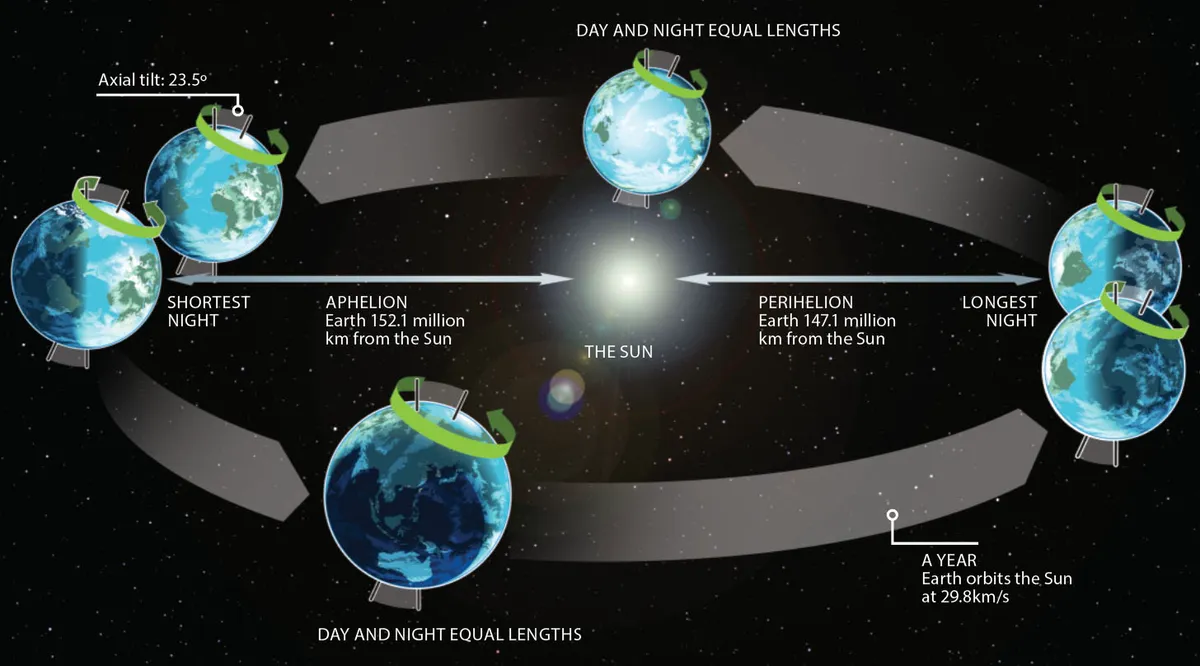
Many people assume the Earth stays the same distance from the Sun all year. But Earth travels around the Sun in an oval-shaped orbit, called an ellipse. Because of this, the distance changes slightly.
Closest Point: Perihelion
Earth is closest to the Sun at a point called perihelion, which happens around early January.
At perihelion, the distance is about:
✅ 91.4 million miles (147.1 million km)
Farthest Point: Aphelion
Earth is farthest from the Sun at a point called aphelion, which happens around early July.
At aphelion, the distance is about:
✅ 94.5 million miles (152.1 million km)
So, the answer to how far away is the sun depends on the time of year, but the average remains 93 million miles.
How Far Away Is the Sun in Astronomical Units (AU)?
Astronomers often use Astronomical Units instead of miles or kilometers because solar system distances are huge.
The Earth-Sun distance is:
✅ 1 AU
Other planets are measured relative to Earth’s distance.
For example:
- Mercury: 0.39 AU
- Venus: 0.72 AU
- Mars: 1.52 AU
- Jupiter: 5.2 AU
Using AU makes it easier for scientists to compare distances across the solar system.
So, when someone asks how far away is the sun, astronomers will often answer:
👉 The Sun is 1 AU from Earth.
How Far Away Is the Sun in Light Minutes?
A very interesting way to measure the Sun’s distance is by using the speed of light.
Light travels extremely fast:
✅ 186,000 miles per second
or
✅ 300,000 kilometers per second
Because of this speed, sunlight takes about:
⏳ 8 minutes and 20 seconds to reach Earth.
This means when you look at the Sun, you are actually seeing it as it was 8 minutes ago.
So another way to answer how far away is the sun is:
👉 The Sun is about 8 light-minutes away from Earth.
How Far Away Is the Sun Compared to the Moon?
To understand how far away the Sun really is, it helps to compare it to the Moon.
The average distance from Earth to the Moon is about:
✅ 238,855 miles (384,400 km)
Now compare that to the Sun:
✅ 93,000,000 miles
This means the Sun is about:
👉 390 times farther away than the Moon.
Even though the Sun is much farther away, it appears almost the same size as the Moon in the sky because it is also much larger.
That is why solar eclipses happen when the Moon blocks the Sun perfectly.
How Far Away Is the Sun in Terms of Travel Time?
If humans could travel to the Sun, how long would it take? The answer depends on the speed of travel.
Traveling by Car
A car traveling at 60 mph would take:
🚗 about 177 years to reach the Sun (without stopping).
Traveling by Airplane
A commercial airplane traveling at 550 mph would take:
✈️ about 19 years to reach the Sun.
Traveling by Rocket
A space rocket traveling around 25,000 mph would take:
🚀 about 5 months to reach the Sun.
Of course, humans cannot actually land on the Sun because it is extremely hot and made of plasma, not solid ground.
Still, these calculations show how massive the distance is.
How Far Away Is the Sun From Other Planets?
The Sun is at the center of our solar system, and each planet has a different distance from it.
Here are approximate distances:
- Mercury: 36 million miles
- Venus: 67 million miles
- Earth: 93 million miles
- Mars: 142 million miles
- Jupiter: 484 million miles
- Saturn: 886 million miles
- Uranus: 1.78 billion miles
- Neptune: 2.8 billion miles
These distances help us understand how large the solar system is.
So when you ask how far away is the sun, remember that Earth is relatively close compared to outer planets.
How Far Away Is the Sun From Earth in Kilometers?
Some countries use kilometers instead of miles. The average Earth-Sun distance is:
✅ 150,000,000 kilometers
This is the number most commonly used in science textbooks and astronomy references.
So if your question is how far away is the sun in km, the answer is:
👉 Approximately 150 million km.
How Far Away Is the Sun: How Scientists Measure the Distance
The Sun is far away, so scientists cannot measure it with a simple ruler or tape. Instead, they use advanced methods.
1. Radar Measurements
Scientists send radar signals to planets like Venus and measure how long it takes for the signal to bounce back. Using that data, they calculate distances within the solar system and estimate the Earth-Sun distance.
2. Parallax Method
Parallax is a technique where scientists observe an object from two different locations and measure the angle shift. This helps calculate distances.
3. Spacecraft Tracking
NASA and other space agencies track spacecraft movements and use mathematical models to calculate the exact distance between Earth and the Sun.
These methods allow scientists to answer the question how far away is the sun with high accuracy.
How Far Away Is the Sun: Why the Distance Matters for Life on Earth
The Earth’s distance from the Sun is not random. It is one of the main reasons why life exists.
Earth is located in the “Goldilocks Zone,” meaning it is not too close or too far.
If Earth Were Closer to the Sun
- Temperatures would rise dramatically
- Oceans could evaporate
- Earth could become like Venus
If Earth Were Farther from the Sun
- The planet could freeze
- Water might become ice permanently
- Life could struggle to survive
This perfect balance is why scientists call Earth’s position ideal.
So the distance is not just a number—it plays a major role in making Earth habitable.
How Far Away Is the Sun: Does Distance Cause Seasons?
Many people believe seasons happen because Earth is closer or farther from the Sun. That is not correct.
Seasons happen mainly because:
🌍 Earth is tilted at 23.5 degrees
When the Northern Hemisphere tilts toward the Sun, it experiences summer. When it tilts away, it experiences winter.
Interestingly, Earth is closest to the Sun in January, which is winter in many countries.
So, even though the distance changes, it is not the main cause of seasons.
How Far Away Is the Sun: How Big Is the Sun Compared to Earth?
The Sun is huge compared to Earth.
Sun Diameter
- About 864,000 miles (1.39 million km)
Earth Diameter
- About 7,917 miles (12,742 km)
This means the Sun’s diameter is:
👉 About 109 times larger than Earth.
Also, the Sun could fit around:
🌎 1.3 million Earths inside it
This fact helps explain why the Sun’s gravitational pull keeps the entire solar system in orbit.
How Far Away Is the Sun: What Is the Sun Made Of?
The Sun is not made of solid material. It is mostly a giant ball of hot gas and plasma.
The Sun is made mainly of:
- Hydrogen (about 74%)
- Helium (about 24%)
- Small amounts of oxygen, carbon, neon, and iron
The Sun produces energy through a process called nuclear fusion, where hydrogen atoms combine to form helium, releasing huge energy.
That energy travels through space and reaches Earth as sunlight.
How Far Away Is the Sun: Can Humans Ever Travel to the Sun?
Even though space agencies can send probes close to the Sun, humans cannot travel to it safely.
Why Humans Cannot Reach the Sun
- The Sun’s surface temperature is about 10,000°F (5,500°C)
- The core temperature is about 27 million°F (15 million°C)
- Solar radiation would destroy spacecraft systems
- The Sun has no solid surface to land on
NASA has sent probes like the Parker Solar Probe to study the Sun, but these probes are designed with special heat shields.
So, while we can explore it, we cannot physically land on it.
How Far Away Is the Sun: Fun Facts You Should Know
Here are some interesting facts that make the Sun even more fascinating.
Sun Facts
- The Sun is about 4.6 billion years old
- It makes up about 99.8% of the solar system’s mass
- Sunlight takes 8 minutes to reach Earth
- It will continue shining for another 5 billion years
- The Sun is a “G-type main-sequence star” (yellow dwarf)
- Its gravity holds planets, asteroids, and comets in orbit
These facts show how important the Sun is for our solar system.
How Far Away Is the Sun: Distance in Scientific Notation
Scientists often write large numbers in scientific notation.
The Earth-Sun distance is:
✅ 1.496 × 10⁸ kilometers
This is a standard way to represent huge distances in astronomy.
